
Your boiler is only part of the heating system. The radiators, pipework, valves, pump and controls all have to work together, and most of the heating complaints we get called out to are not boiler faults at all.
We install complete central heating systems, extend and upgrade existing ones, and fix systems across Dewsbury, Wakefield, Huddersfield, Bradford and Halifax.
Calculated Heat Loss
Correctly sized radiators for every room.
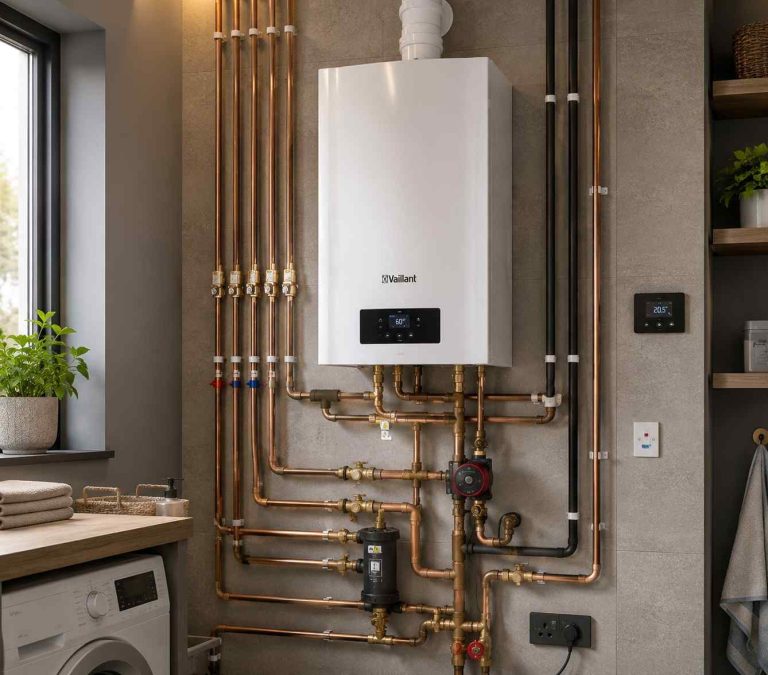
Putting a heating system into a property that has never had one, or replacing a system that has come to the end of its life. That means a heat loss calculation for each room, correctly sized radiators, properly sized pipework, a boiler matched to the load, and controls that let you heat the rooms you are using.
We work to the sizing rather than to a guess. An undersized radiator in the coldest room is the reason so many houses have one room nobody sits in.
Swapping old radiators for modern ones with better output, moving them to make a room work better, or upsizing where a room has never been warm enough.
Extensions, loft conversions and garage conversions all need heat. We check whether the existing boiler and pipework can carry the extra load before adding to it, because bolting extra radiators onto a system already at capacity makes the whole house worse.
Cold at the top is trapped air and needs bleeding. Cold at the bottom is sludge and needs the system cleaning — see power flushing. One radiator cold when all the others are hot is usually a stuck valve or a balancing problem.
If the radiators nearest the boiler are hot and the ones at the far end are lukewarm, the system is not balanced. Each radiator has a lockshield valve that controls flow, and setting them correctly across the whole system is a job that takes time and a pair of thermometers. It is skipped far more often than it should be, and it is frequently the actual answer to “the upstairs is fine but the front room is freezing”.
Good controls save more money than most efficiency upgrades. We fit and configure:
Room thermostats and programmable thermostats
Smart controls such as Nest, Hive and Tado
Thermostatic radiator valves (TRVs), so each room can be set separately
Zone valves and multi-zone systems, so upstairs and downstairs run independently
Cylinder thermostats and timers
If you have a smart thermostat that has never worked properly, the fault is usually in how it was wired to the boiler rather than in the thermostat itself.
Common jobs:
Pump failure or a seized pump
Stuck or failed motorised zone valves
Leaking radiator valves and pipe joints
Cold spots and poor circulation
Noisy pipework and banging
Airlocks
Frozen pipes in cold spells
Systems that will not fill or hold pressure
Two things come up constantly in this district.
Very common in 1970s and 1980s installations. The pipes are 8mm or 10mm, which restricts flow and silts up far faster than 15mm. Symptoms are radiators that take a long time to warm up and never get properly hot. Sometimes it can be cleaned and rebalanced. Sometimes it needs replacing, and we will tell you honestly which.
Older still, and found in plenty of stone terraces. Every radiator feeds off one loop, so each one cools the water for the next. The last radiator in the circuit will never be as hot as the first, no matter how much balancing you do. Converting to a two-pipe system is the real fix.
Complete central heating installations, radiator replacements, system balancing, and pipe repairs across West Yorkshire. Select your area:
WF12, WF13, WF16, WF17
Dewsbury, Batley, Thornhill, Ravensthorpe, Heckmondwike
View Dewsbury Heating →WF1 – WF5
Wakefield, Sandal, Lupset, Outwood, Stanley, Ossett
View Wakefield Heating →HD1 – HD5
Huddersfield, Lindley, Almondbury, Marsh, Dalton, Birkby
View Huddersfield Heating →BD1 – BD10
Bradford, Manningham, Heaton, Wibsey, Eccleshill, Thornton
View Bradford Heating →HX1 – HX3
Halifax, King Cross, Skircoat Green, Boothtown, Ovenden
View Halifax Heating →Ring 07866 623870 or message us on WhatsApp with your heating requirements. We provide accurate heat loss calculations and fixed written quotes.
Areas: Dewsbury · Wakefield · Huddersfield · Bradford · Halifax
.png)
