

The shower runs cold. The radiators have gone quiet. The house, which was fine yesterday, now feels like it belongs to November.
If you are looking for boiler repairs in Bradford, you probably want two things: to know whether there is anything you can safely try yourself, and to know when it is time to hand it over. This guide covers both. It also covers the handful of things you should never touch, however confident the video tutorial made it look.
Safety first: two situations where you stop and ring for help
Before you look at the fault, rule out the two problems that matter more than a cold house.
If you smell gas: Open doors and windows, turn the gas off at the meter if you can reach it safely, and do not operate light switches or electrical appliances. Leave the property and call the National Gas Emergency Service on 0800 111 999. It is free and answered 24 hours a day.
If you suspect carbon monoxide: The warning signs are headaches, dizziness, nausea, tiredness and breathlessness, especially if they ease when you leave the house. Yellow or orange flames instead of a steady blue one, or dark staining around the boiler, are also red flags. Switch the boiler off, get everyone into fresh air and call a Gas Safe registered engineer. Do not use the appliance again until it has been checked.
A working carbon monoxide alarm near the boiler is cheap and worth having. It does not replace servicing, but it can be the thing that alerts you.
What should I check when my boiler stops working?
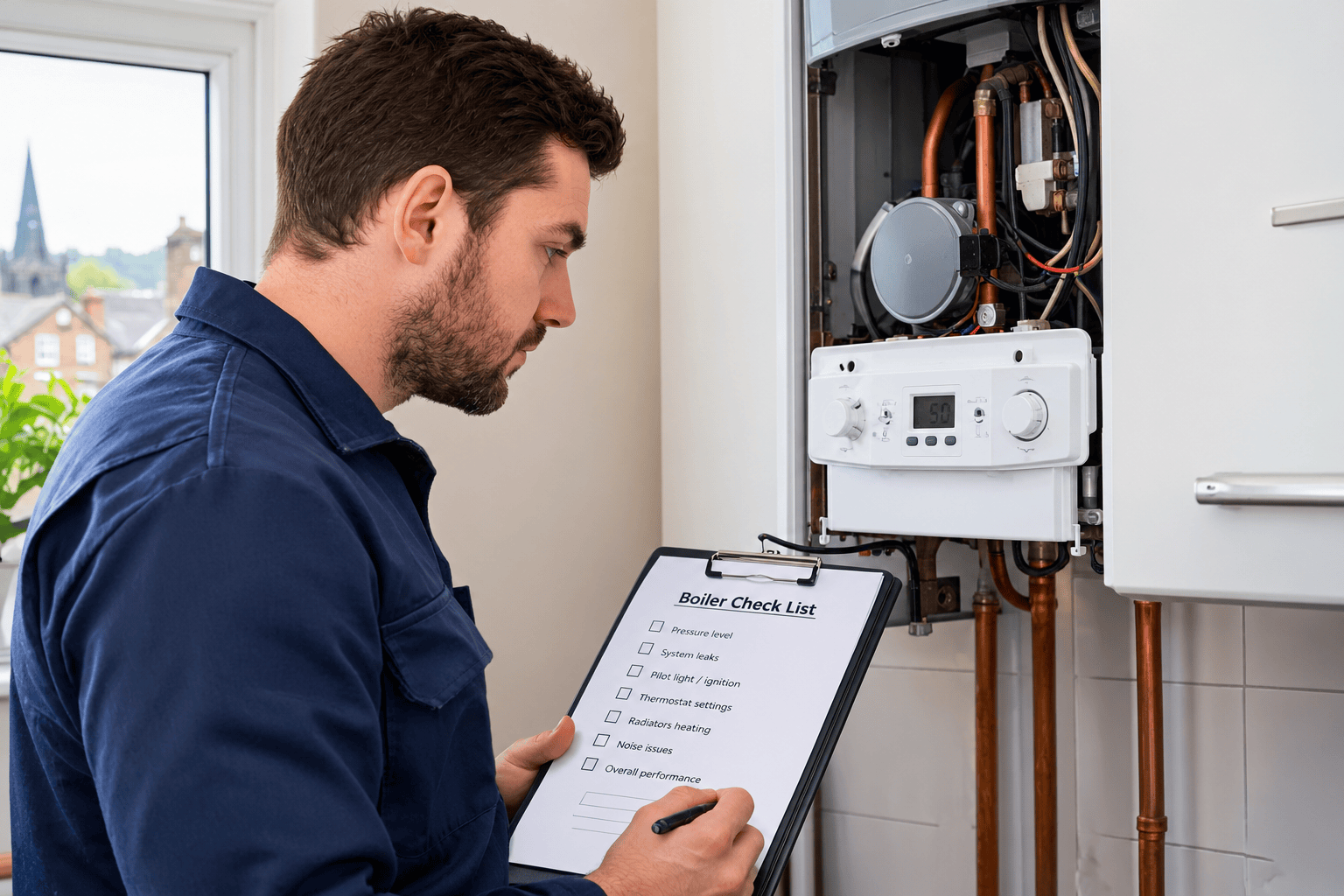
If your boiler has stopped working, check that the gas and electricity are on, the thermostat is calling for heat with fresh batteries, and the pressure gauge reads roughly 1 to 1.5 bar when the system is cold. Try one reset following the manufacturer’s instructions. If it locks out again, stop and call a Gas Safe engineer.
Here is the sequence in a bit more detail:
- Check the supplies. Is the power on at the boiler, and is the gas on? If you have a prepayment meter, check you have not simply run out of credit. A neighbour’s lights working does not mean your gas supply is fine, so check your own appliances too, such as the hob.
- Look at the controls. Programmers get knocked, thermostats lose their batteries, and a heating schedule can reset after a power cut. Make sure the heating is actually calling for heat before you blame the boiler.
- Read the pressure gauge. Most sealed systems sit somewhere around 1 to 1.5 bar when cold. Check the manual for your specific model, because it varies.
- Look at the display. Many modern boilers show a fault code. Write it down, along with the make and model. It will save time on the phone and may help the engineer bring the right part.
- Try a single reset. Once. If the boiler fires up and then locks out again, repeated resets will not fix it. They can mask what is actually going wrong.
During a cold snap there is one more check worth doing. Many condensing boilers drain through an external plastic pipe, and in freezing weather that pipe can freeze and shut the boiler down. If you can see the pipe and it is clearly frozen, pouring warm (never boiling) water over it can get things moving again. If you cannot reach it safely or you are unsure, leave it for an engineer.
What your boiler’s symptoms are usually telling you
A boiler is not mysterious once you know what it is doing when it fails. These are the patterns engineers see most often. They are possibilities rather than diagnoses, because the same symptom can have several causes.
Heating works, but there is no hot water (or the reverse). On a combi boiler this often points to a component that switches the boiler between heating and hot water, such as a diverter valve, or to a restricted heat exchanger. It can also be a controls fault. This is not something to guess at.
Pressure keeps dropping. If you have to top the system up every few weeks, water is going somewhere. It could be a small leak at a radiator valve or joint, or a fault in the pressure relief valve or expansion vessel. Topping up using the filling loop is fine when your manual says so, but a repeated drop is a symptom, not a routine.
Banging, whistling or “kettling” noises. These usually mean restricted water flow, often caused by scale or sludge in the system. The boiler overheats the water locally and the noise follows. Left alone, it puts extra strain on the heat exchanger.
Radiators hot at the top and cold at the bottom. This is classic sludge. Magnetite and debris settle in the lowest part of the radiator and block circulation. Bleeding will not cure it. A system clean such as power flushing usually will.
The boiler fires up, then shuts down repeatedly. This is called a lockout. Causes range from ignition and flame-sensing problems to blocked condensate drains and low pressure. Repeated resets are not the answer.
Water around or underneath the boiler. Turn the boiler off and, if you can, isolate the water supply to it. A leak near a boiler is a combined plumbing and electrical hazard, so treat it as urgent.
What you should not do yourself
Bleeding a radiator and topping up pressure from the filling loop are reasonable homeowner jobs. Almost everything beyond that is not.
Gas work in the UK is legally restricted to Gas Safe registered engineers, and the reasons are practical rather than bureaucratic. Do not:
- Remove the boiler’s sealed casing
- Adjust gas valves or burner settings
- Interfere with the flue or ventilation
- Keep resetting a boiler that keeps locking out
- Use an unregistered “handyman” because he was cheaper or available sooner
Any engineer you let in should show their Gas Safe ID card without being asked. You can also check them on the Gas Safe Register website. It takes less than a minute, and any genuine engineer will expect it.
What actually happens when an engineer comes out
People often put off calling because they expect a sales pitch or a surprise bill. A good repair visit should be straightforward.
The engineer asks what happened and when, then looks at the boiler’s behaviour, checks safety and operation, and finds the fault. Many boiler problems can be diagnosed and fixed on the first visit, particularly when the engineer carries common parts for the main makes. If a part has to be ordered, a responsible engineer makes the property safe and tells you plainly when they can come back.
At A S Plumbing and Heating Engineers, quotes are given before work starts, and there is no callout fee for standard enquiries. If something turns up that could not have been seen at the outset, you are told before the price changes. That is how it should work wherever you book.
Repair or replace: how to think about it
Not every faulty boiler deserves a new part. A fair way to weigh it up:
- Age. An older boiler that has had one fault is different from one that has had three in a year.
- Parts. For some older models, parts are no longer made. In that case an honest engineer will say so rather than charge you to find out.
- The system around it. A new boiler connected to a sludged-up system will struggle. Sometimes the right repair is cleaning the system, not changing the boiler.
- Running costs. Older boilers generally waste more fuel than modern condensing models, which matters when energy bills are already a worry.
If replacement does turn out to be the sensible route, a proper boiler installation and replacement starts with a survey and a sizing check based on your actual hot water demand, not a standard package.
Bradford homes and boilers: what is different here
Bradford’s housing stock shapes how boiler faults show up. Back-to-backs and stone terraces often have boilers in cellars, under stairs or in cramped kitchen cupboards. Flue routes can be awkward, and access is not always generous. Converted mills and older properties can have pipework that has been altered several times over the decades. Engineers who know these property types tend to find faults faster because they have worked around the same constraints before.
Weather plays a part too. With the Pennines nearby, cold snaps arrive with little warning, and the first hard frost of the year is when frozen condensate pipes and tired boilers tend to show themselves. If your boiler has been making unusual noises or struggling to reach temperature, autumn is the time to deal with it, not January.
That is also where a boiler service in Bradford earns its keep. An annual service will not make a boiler immortal, but it can catch a worn component or a slow pressure loss before it becomes an emergency. In most cases it is also a condition of the manufacturer’s warranty, so a missed service can cause problems later.
When it is a genuine emergency
Some situations should not wait for a convenient appointment. Ring straight away for emergency boiler repair in Bradford if:
- You have no heating or hot water and anyone in the home is elderly, very young or unwell
- There is a leak near the boiler or water coming through a ceiling
- The boiler is making unusual noises alongside a smell or visible scorching
- You suspect carbon monoxide (leave the property first)
For genuine emergencies, A S Plumbing runs a 24/7 emergency callout. Bradford is a few hours’ drive from the Dewsbury base depending on traffic and workload, so you are given a realistic window rather than an optimistic one.
What to have ready when you ring
A short, clear call gets you help faster. Have these to hand:
- The boiler make and model (usually on the front or on a data plate)
- Roughly how old it is
- Any fault code on the display
- What happened just before it stopped (a power cut, a noise, a leak)
- The current pressure reading
- Whether you have smelled gas or have any other safety concern
With the make and model, the engineer can often bring the likely part along, which can save a second visit.
FAQ’s
Is it safe to keep using my boiler if it is leaking?
No. Turn it off, isolate the water supply to it if you can, and call an engineer. A leak near the boiler can damage components and creates a safety risk because of the electrics inside.
Can I top up my boiler pressure myself?
Usually yes, using the filling loop, if your manual says that is how it works for your model. If the pressure keeps falling, there is a leak or a component fault, and topping up repeatedly will not fix it.
Who is responsible for fixing the boiler in a rented home?
In most rented homes in England, the landlord is responsible for keeping the heating and hot water installation in working order. Tenants should report faults promptly and in writing, and should not attempt gas repairs themselves.
How do I know whether an engineer is genuinely Gas Safe registered?
Ask to see their ID card, then check their registration number on the Gas Safe Register website. The back of the card also lists the types of gas work they are qualified to do.
How often should a boiler be serviced?
Once a year is the usual recommendation, and many manufacturers require it to keep the warranty valid. An annual visit is also the best chance of spotting wear before it leads to a breakdown.
What should I tell the engineer when I call?
Give the make, model, approximate age, any fault code, what happened before it stopped and the current pressure. If you smelled gas or felt unwell, say so first.
Is it worth repairing an old boiler?
Often yes, if the fault is isolated and parts are available. If the boiler is having repeated faults, parts are hard to find, or it is costing a lot to run, replacement may be the better long-term decision. A good engineer will explain both options honestly.
Boiler stopped working in Bradford?
If you have run through the checks above and the boiler is still not firing, stop resetting it and let an engineer take a proper look. A S Plumbing and Heating Engineers are Gas Safe registered (No. 211549), the same engineer does the diagnosing and the repair, and you get a clear quote before any work begins.
Call or WhatsApp 07866 623870 for an emergency callout, or request a free no-obligation quote with your boiler’s make, model and fault code. If your boiler is working but overdue its annual check, you can also book a boiler service before the cold weather arrives.
.png)